
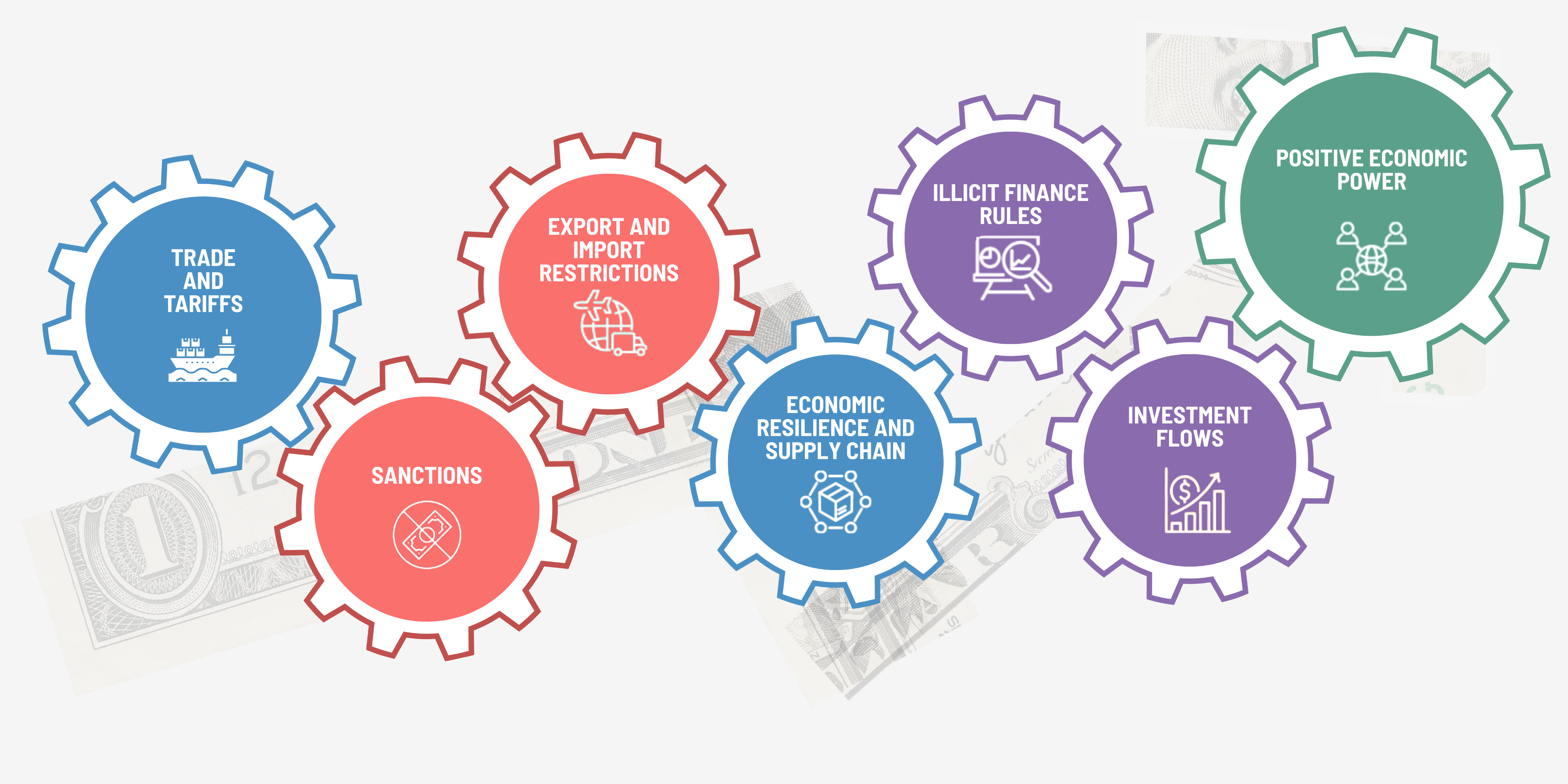

Gears of National Economic Power

Gears of National Economic Power

America’s economic statecraft tools — sanctions, tariffs, export controls, investment screening, anti-money laundering laws, foreign assistance, and supply-chain resiliency measures — are not standalone levers, they are gears in a single engine of national power. To be effective, they must move in concert, coordinated across agencies, and aligned with allies to defend U.S. interests, deter adversaries, and power a stable, free, open, and fair Near-Global Economy.
Trade tools Punitive tools Illicit Finance Rules Positive tools
Trade tools

Trade and Tariffs

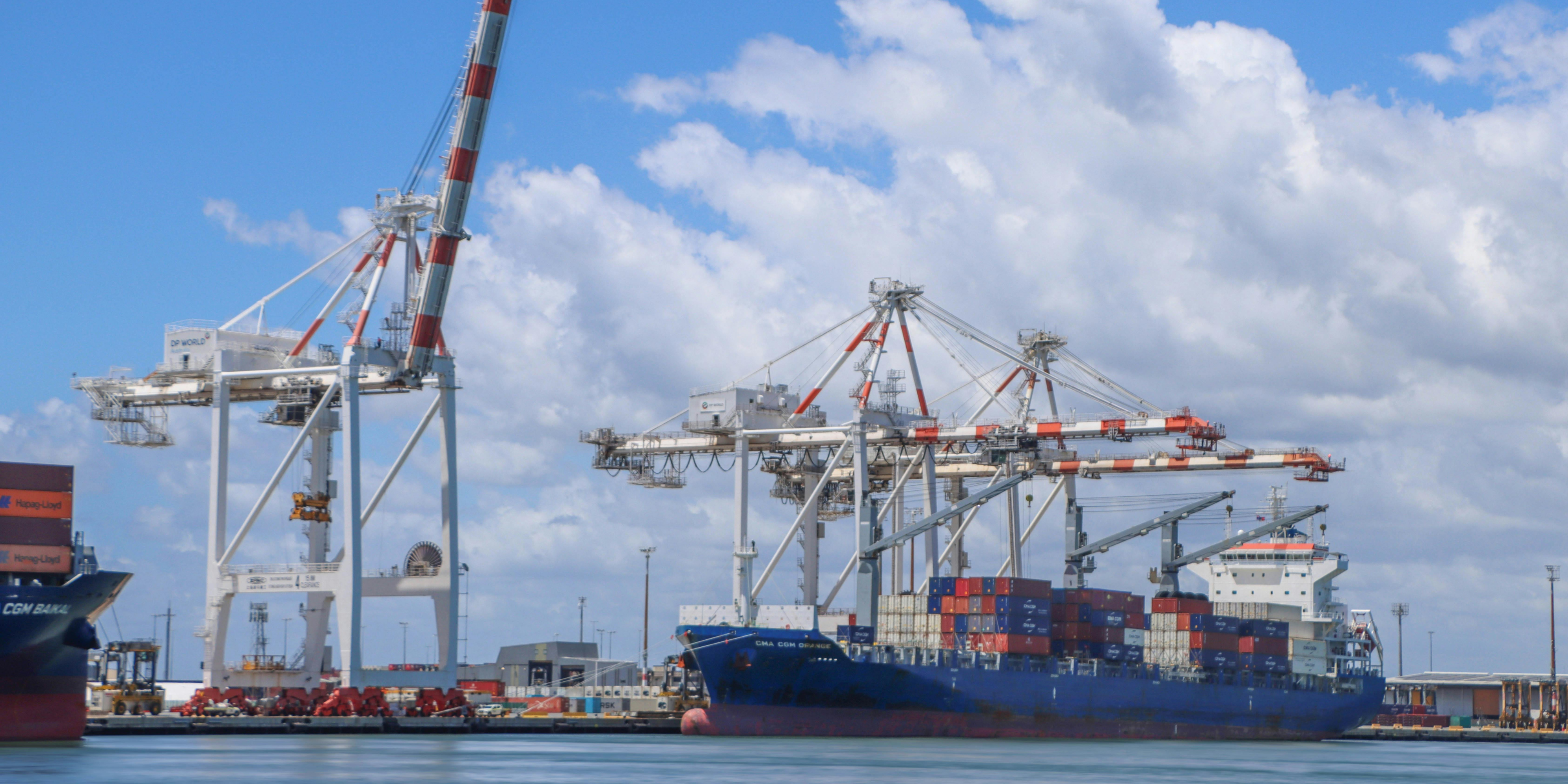
Trade policies — like tariffs, free trade agreements, and free trade zone legislation — use access to the United States’s powerful economy as a form of leverage. A wide range of Executive Branch agencies exercise power over trade, and Congress’s power over treaties, regulation of commerce, and legislation also give it significant authority over this engine of economic power.

Punitive tools

Sanctions

Sanctions restrict bad actors’ ability to access funds and engage in commercial activity. Sanctions can be broad and comprehensive or narrowly tailored to specific types of transactions and/or individuals.
Punitive tools

Export and Import Restrictions

Export and import restrictions control access to particular goods and sectors. Such controls can be used to restrict foreign access to sensitive American technologies — such as military technologies. They can also be used to protect specific American economic sectors or prevent dependence on a foreign producer for a good.
Trade tools

Economic Resilience and Supply Chain

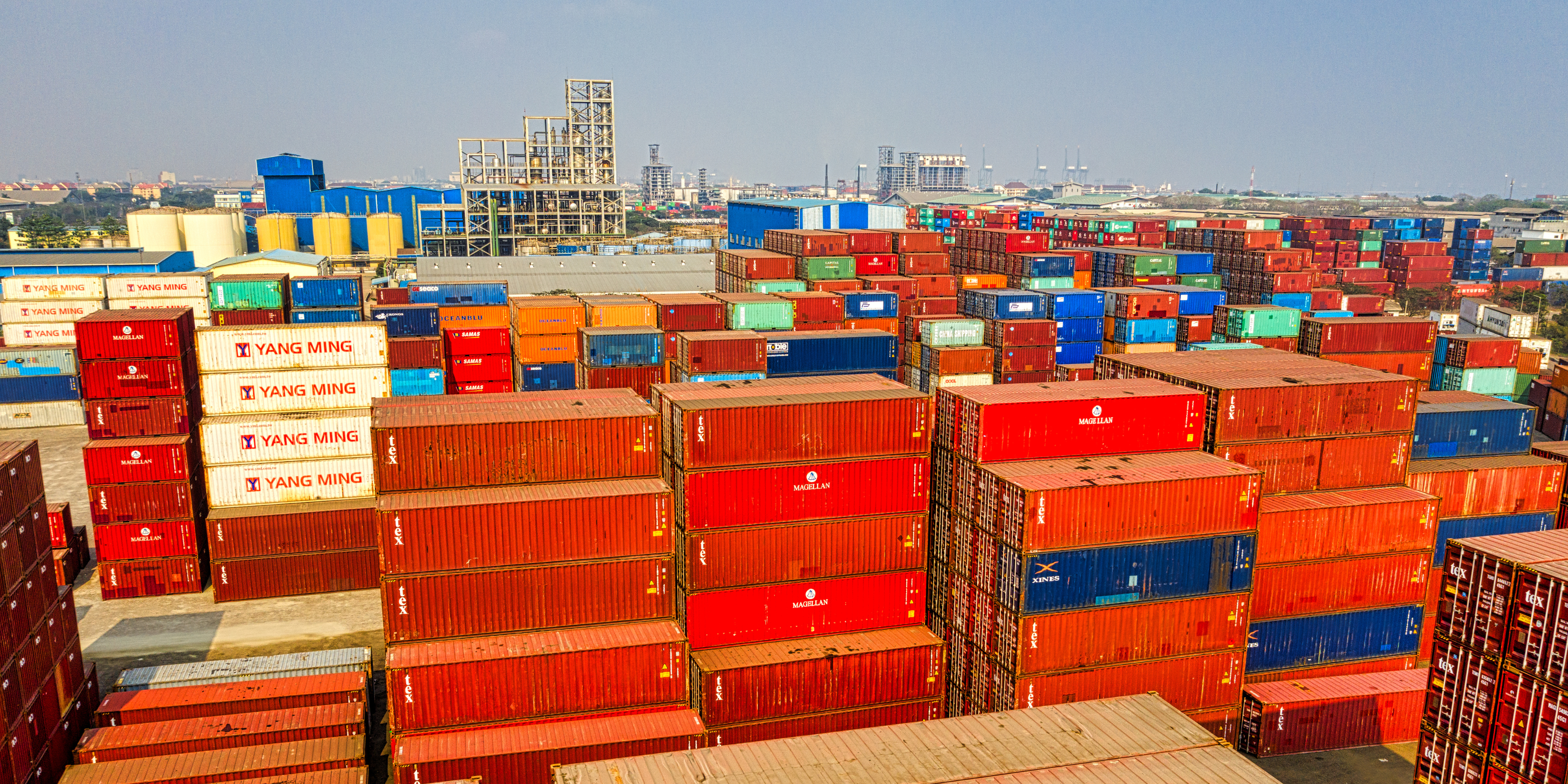
Economic resilience tools reduce U.S. dependence on adversarial supply chains, secure access to critical materials and technologies, and ensure the industrial base can sustain national defense and economic competitiveness. These tools combine industrial policy, investment screening, and strategic reserves to buffer against disruption.

Illicit Finance Rules

Illicit Finance Rules

Illicit finance rules can counter the movement of dirty money by exposing hidden ownership structures, shady networks, and money laundering that enables sanctions evasion, corruption, and adversarial economic influence. By requiring systemic responses to red flags, these tools support enforcement across other gears of economic power.

Punitive tools

Investment Flows

Investment flow tools screen inbound foreign capital for national security risks and restrict outbound U.S. investment in adversarial economies. By monitoring and pruning investment in sensitive U.S. sectors — and American capital flows abroad — these tools prevent adversaries from acquiring critical technologies and capabilities.

Positive tools

Positive Economic Power

Positive economic power uses U.S. financial resources, development tools, and trade capacity to build relationships with partner nations, compete with adversarial economic influence, and advance U.S. strategic interests. These tools offer alternatives to dependence on adversarial actors — particularly in infrastructure, energy, and technology.

The U.S. economy is the largest in the world and the United States is the world’s leading importer. Given America’s huge consumer market, it has acted as the primary recipient of goods for many of the world’s export-dependent economies, most notably China. While systemic bilateral trade imbalances can have negative consequences over the long-term, they also provide the United States with substantial leverage over exporting nations, including adversaries.

The United States has the leverage and leadership platform to establish basic rules of economic engagement rooted in free, fair, and efficient trade.

Key Institutions

    Legal Authority Year Core Power Granted Primary Implementing Agencies
    Trade Expansion Act of 1962 (Section 232) 1962 Authorizes the president to work to “adjust the imports of an article and its derivatives” through policy measures in response to investigations conducted by the Department of Commerce’s Bureau of Industry and Security President, Department of Commerce Bureau of Industry and Security
    Trade Act of 1974 (Section 301) 1974 Authorizes the U.S. Trade Representative to investigate unfair trade practices and adopt reactive measures — such as tariffs or trade agreement suspensions U.S. Trade Representative
    Trade Act of 1974 (Section 201) 1974 Authorizes the investigation of foreign imports which may threaten U.S. industries and the adoption of “safeguard” measures (such as tariffs) to protect the industries President, U.S. International Trade Commission (USITC)
    Trade Agreements Act of 1979 Congress.gov FederalRegister.gov USLegalForms.com Heritage.org 1979 Provides for the adoption of related trade agreements and a stronger system of global trade rules, in accordance with the Tokyo Round multilateral negotiations Department of Commerce, U.S. Trade Representative, U.S. International Trade Commission, Department of Agriculture
    Omnibus Trade and Competitiveness Act of 1988 1988 Empowers the U.S. Trade Representative to react to unfair foreign trade practices and trade imbalances — requiring action in some instances; Builds on existing Section 301 authorities U.S. Trade Representative

    There are more than 18,000 individuals, entities, and jurisdictions currently subject to U.S. sanctions.

    But sanctions can be far more effective — with added resources for enforcement, secondary sanctions applied to enablers of evasion, flexibility to support compromise, and integration into a larger strategy.

    Key Institutions

      Legal Authority Year Core Power Granted Primary Implementing Agencies
      Trading with the Enemy Act (TWEA) Congress.gov USLegalForms.com 1917 Authorizes the president to sanction countries or entities deemed a threat and to prevent economic engagement with them — subsequent legislation limits these powers to wartime use. President, Department of the Treasury (OFAC)
      United Nations Participation Act of 1945 1945 Requires the president to transpose United Nations sanctions into U.S. sanctions and creates supporting pathway. President, Department of the Treasury (OFAC)
      International Emergency Economic Powers Act (IEEPA) 1977 Authorizes the president to use a broad range of punitive economic statecraft tools (including, but not limited to, blocking foreign exchange transactions) in response to an "unusual and extraordinary threat" President, Department of the Treasury (OFAC)
      Foreign Narcotics Kingpin Designation Act 1999 Authorizes the blocking of assets of foreign narcotics traffickers, relying on diplomatic, defense, and intelligence actors to distinguish potential targets. President, Department of the Treasury (OFAC)
      Global Magnitsky Human Rights Accountability Act 2016 Authorizes the president to target human rights violators and corrupt actors with economic sanctions and visa restrictions. Department of the Treasury (OFAC), Department of State, attorney general
      Countering America’s Adversaries Through Sanctions Act (CAATSA) State.gov Treasury.gov 2017 Builds on existing sanctions programs for Iran, North Korea, and Russia and requires the president to designate entities supporting Russia's war machine for sanctions. President, Department of the Treasury (OFAC), Department of State
      FEND Off Fentanyl Act Senate.gov Cadwalader.com 2024 Targets the financial assets of illicit supply chains, particularly targeting Chinese chemical suppliers and Mexican drug cartels, mandating property-blocking sanctions against entities involved in trafficking fentanyl or its precursors. President, Department of the Treasury (OFAC)

      Export controls have been chronically circumvented by malign actors, used more to send messages of disapproval than to effectively restrict access. However, tailored action, enforcement, and coordination with allies can impose substantial penalties for those that circumvent American rules.

      Key Institutions

        Legal Authority Year Core Power Granted Primary Implementing Agencies
        Tariff Act of 1930 (Section 307 — Imports Produced by Forced Labor) 1930 Bans the import of goods developed in reliance on forced labor. Customs and Border Protection
        Arms Export Control Act (AECA) (formerly the Foreign Military Sales Act of 1968) DCSA.mil DCSA.mil State.gov 1976 Governs foreign military sales and commercial military-linked equipment sales, operating in part through the International Traffic in Arms Regulations President, Department of Defense, Department of State
        Export Administration Act of 1979 BIS.gov Columbia.edu 1979 Adopts Export Administration Regulations (EARs) on the export of risky dual-use items Department of Commerce (BIS)
        Export Control Reform Act (ECRA) of 2018 2018 Authorizes the president to adopt export controls on dual-use items, without an expiration date. Department of Commerce (BIS)
        Uyghur Forced Labor Prevention Act (UFLPA) DHS.gov CBP.gov CBP.gov 2021 Mandates that the Department of Homeland Security's Forced Labor Enforcement Task Force form an approach to block imports of goods produced with forced labor; adopts the presumption that goods sourced from China's Xinjiang Uyghur Autonomous Region were produced with forced labor Department of Homeland Security, Customs and Border Protection

        America must reinforce its supply chains — making them resilient, flexible, and free from foreign threats and intimidation.

        Ally-shoring describes the need to move critical supply chains and core trade from our adversaries to our allies. In recent years, this process has picked up steam, but it must be both accelerated and institutionalized.

        Ally-shoring also generates concrete benefits for American workers and businesses — establishing reliable supply lines for American products, providing essential components for advanced American goods, while also boosting friendly markets that are likely, in turn, to buy U.S. products.

        Key Institutions

          Legal Authority Year Core Power Granted Primary Implementing Agencies
          Defense Production Act of 1950 (DPA) Congress.gov GAO.gov 1950 Authorizes the president to manage U.S. industry for national defense and emergency preparedness requirements; provides a basis for the creation of the Committee on Foreign Investment in the United States. President, Department of Defense, Department of Commerce, Department of Agriculture, Department of Energy, Department of Homeland Security, Department of Health and Human Services, Department of Transportation, CFIUS
          Trade Expansion Act of 1962 (Section 232) 1962 Grants the president authority to restrict imports and conduct trade negotiations in cases of risk to national security. President, Department of Commerce
          Energy Policy and Conservation Act (EPCA) Energy.gov Energy.gov 1975 Establishes the Strategic Petroleum Reserve (SPR), authorizing the president to release emergency crude oil stocks to counter supply disruptions. President, Department of Energy
          CHIPS and Science Act 2022 Strengthens U.S. semiconductor manufacturing, research and development, and technological leadership against global competition and to reduce reliance on foreign supply chains. Department of Commerce, Government Accountability Office (GAO), Department of Energy, NIST, National Science Foundation (NSF)
          Inflation Reduction Act of 2022 (IRA) Energy.gov 2022 Provides funding to incentivize American manufacturing through tax credits and directly, with domestic content requirements designed to strengthen supply chains for batteries, critical minerals, and clean energy components. Department of the Treasury, Department of Energy
          National Defense Authorization Act (NDAA) Congress.gov Annual Authorizes annual defense spending and establishes defense policies, restrictions, and broad-level indication of intended direction for defense-related activities. Department of Defense, Department of Energy

          America’s enemies depend on the shadows of our financial system to raise and move money. Enforcing the rules that expose that activity — and mandate action from banks, law enforcement, and monitoring actors — are critical to cutting off the cash that sustains illicit actors.

          Key Institutions

            Legal Authority Year Core Power Granted Primary Implementing Agencies
            Bank Secrecy Act (BSA) Treas.gov Congress.gov FinCEN.gov 1970 Established requirements for financial institutions to maintain records, report suspicious transactions, and establish compliance programs to detect and prevent money laundering and illicit finance Department of the Treasury (FinCEN)
            Foreign Corrupt Practices Act of 1977 (FCPA) Justice.gov 1977 Prohibits bribery of foreign officials and establishes record keeping and accounting provisions for companies Department of Justice, Securities and Exchange Commission
            International Emergency Economic Powers Act (IEEPA) 1977 Provides broad authority to the president to impose economic-based sanctions — including tariffs — in the event of a declared national emergency President, Department of the Treasury
            USA PATRIOT Act (Title III, Section 311) 2001 Empowers treasury secretary with a broad swath of tools to combat money laundering and terror financing risks, including identifying foreign jurisdictions or entities as a ‘primary money laundering concern,’ subjecting the jurisdiction or entity to heightened regulatory measures Department of the Treasury
            Anti-Money Laundering Act of 2020 (AML) 2020 Modernizes the U.S. AML regime first established under the BSA; expands beneficial ownership reporting disclosure and transparency requirements; and strengthens information sharing and enforcement tools Department of the Treasury (FinCEN)
            Corporate Transparency Act (CTA) FinCEN.gov FDD.org 2021 Requires disclosure of beneficial ownership information for U.S. incorporated companies to prevent anonymous shell companies. Enforcement suspended as of 2025 pending legal challenges Department of the Treasury (FinCEN)
            Foreign Extortion Prevention Technical Corrections Act (FEPA) 2024 Criminalizes the demand, acceptance, or receipt of bribes by foreign officials from U.S. persons or companies operating abroad Department of Justice

            Since President Gerald Ford established the Committee on Foreign Investment in the United States (CFIUS) in 1975, the screening of foreign investment has been a key tool to protect American national security.

            While foreign investment is often a lifeline to an emerging economy, it can also be a key entry point for surveillance, intellectual property theft, or uncontrollable market dumping. Adversarial investment in major allied countries adds an additional layer of complication — and necessitates coordinated screening.

            Key Institutions

              Legal Authority Year Core Power Granted Primary Implementing Agencies
              Defense Production Act (Section 721) (also known as the Exon-Florio amendment) 1950 Establishes presidential authority to review and block foreign investment in U.S. companies for national security risks (statutory basis for CFIUS) President, Committee on Foreign Investment in the United States
              International Emergency Economic Powers Act (IEEPA) 1977 Provides authority limit foreign investment by U.S. persons in areas critical to national security President, Department of Commerce, Department of the Treasury
              Foreign Investment Risk Review Modernization Act of 2018 (FIRRMA) 2018 Expands CFIUS authority to include non-controlling investments, critical technologies, sensitive data, and real estate Committee on Foreign Investment in the United States
              Executive Orders on Investment Restrictions (EO 13959 and EO 14032) FederalRegister.gov FederalRegister.gov 2020, 2021 Prohibits U.S. investment in certain foreign companies linked to adversarial governments, primarily China’s Department of the Treasury (OFAC), Department of Defense
              Executive Order on Outbound Investment Screening (EO 14105) 2023 Creates restrictions on U.S. investment in sensitive technologies of adversarial countries. Department of the Treasury, Department of Commerce
              Executive Order on Ensuring Consideration of Evolving National Security Risks by CFIUS (EO 14083) GovInfo.gov Treasury.gov 2022 Expands CFIUS’s scope of review to include a broader range of transactions Committee on Foreign Investment in the United States

              America’s economic statecraft has long been defined more by its restrictions than its inducements. In a world of intensifying geoeconomic competition, this punitive bias cedes the initiative to authoritarian powers peddling investments greased with bribes.

              America must provide a compelling counteroffer. The government’s ability to invest in and support partners demonstrates the tangible benefits from alliance with the American-led economic system. Many public sector entities (including geoeconomic programs like Prosper Africa) translate U.S. positive economic power into specific regional strategies.

              Key Institutions

                Legal Authority Year Core Power Granted Primary Implementing Agencies
                Gold Reserve Act of 1934 1934 Authorizes Treasury’s Exchange Stabilization Fund for emergency financial support to partner governments Department of the Treasury
                Export-Import Bank Act USA.gov State.gov 1945 Establishes EXIM as the official export credit agency of the U.S. to facilitate American export competitiveness around the world by providing loans, guarantees, and insurance Export-Import Bank of the United States
                Bretton Woods Agreements Act GovInfo.gov CFR.org 1945 Authorizes U.S. membership in the IMF and World Bank, enabling financial contributions and positioning the United States at the core of global financial stability and development financing — a legal authority that continues despite the end of the Bretton Woods System Department of the Treasury
                Agricultural Trade Development and Assistance Act of 1954 (Food for Peace Act / P.L. 480, 1954) 1954 Establishes a permanent means by which to share surplus items with partner states U.S. Department of Agriculture
                Foreign Assistance Act Congress.gov State.gov 1961 Authorizes the foundational framework for U.S. foreign assistance including economic development, military assistance, and contributions to international organizations. Also mandates the establishment of a single agency to administrate foreign aid, historically USAID (Formerly) the U.S. Agency for International Development, Department of State
                International Financial Institutions Act 1977 Governs U.S. participation in international financial institutions (IFIs) and MDBs, directing U.S. representatives to advance human rights, environmental, and poverty reduction standards Department of the Treasury
                Agricultural Trade Act of 1978 Congress.gov USDA.gov 1978 Supports the Export Credit Guarantee Program and financing for developing partners to purchase agricultural goods on credit U.S. Department of Agriculture
                Trade and Development Act 2000 Extends preferential trade benefits and conditional market access to certain emerging markets to promote U.S. exports and development; foundational legislation for the African Growth and Opportunity and Caribbean Basin Trade Partnership Acts U.S. Trade Representative, Customs and Border Protection
                Millennium Challenge Act 2003 Establishes the Millennium Challenge Corporation to provide large-scale grants to developing nations conditioned on commitments to democratic governance, economic freedom, and investment in their people Millennium Challenge Corporation
                BUILD Act (Better Utilization of Investments Leading to Development) Congress.gov MCC.gov 2018 Establishes the U.S. International Development Finance Corporation, expanding U.S. capacity for private sector-led development finance through loans, loan guarantees, equity investments, and political risk insurance around the world Development Finance Corporation
                See more A Gameplan for American Economic Security: Supercharging U.S. Statecraft, from an Economic Pentagon to the Near-Global Economy

                Research by Elaine K. Dezenski & Josh Birenbaum

                Visual by Angela Howard & Susan Soh

                Edited by Jason Fields & Pavak Patel